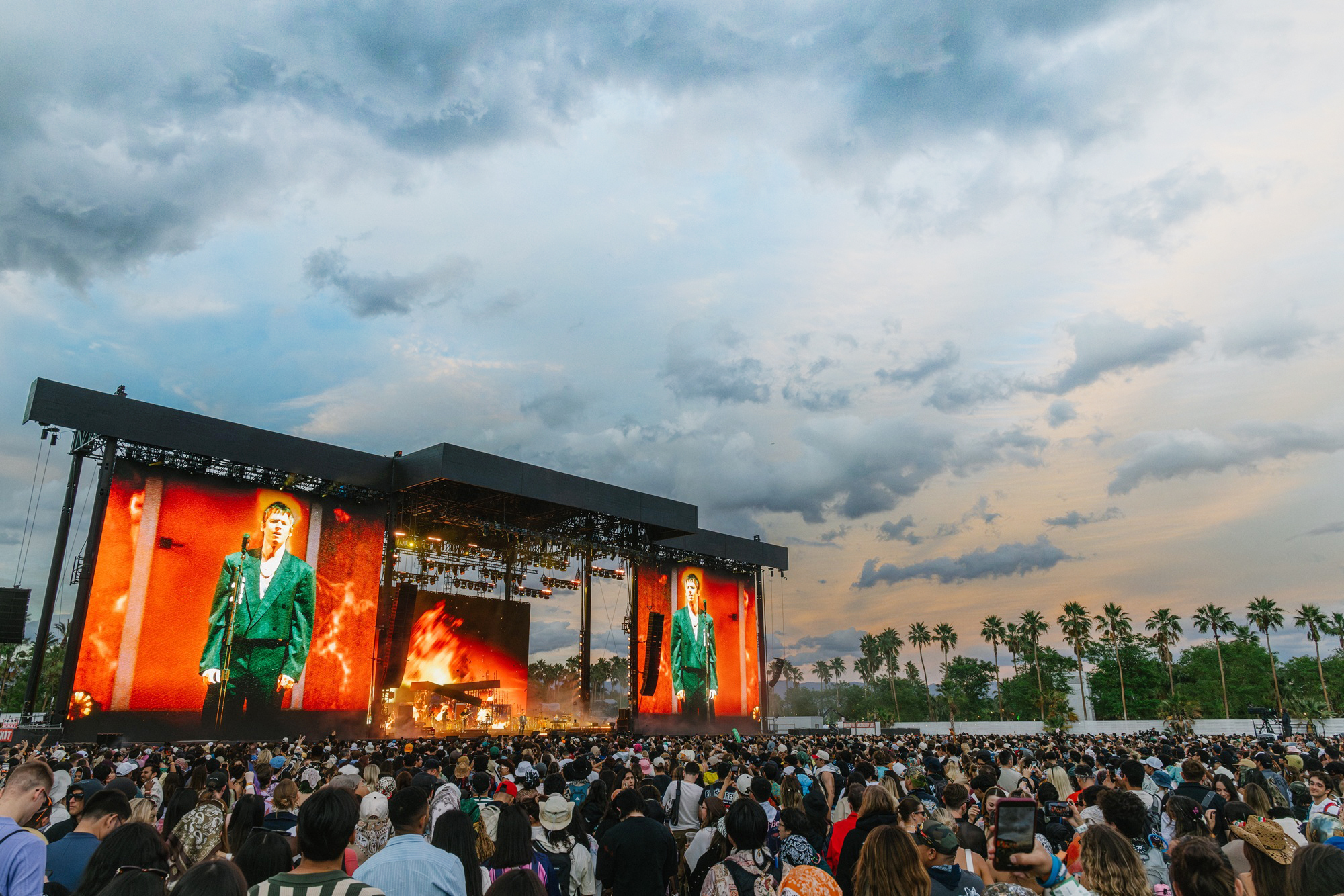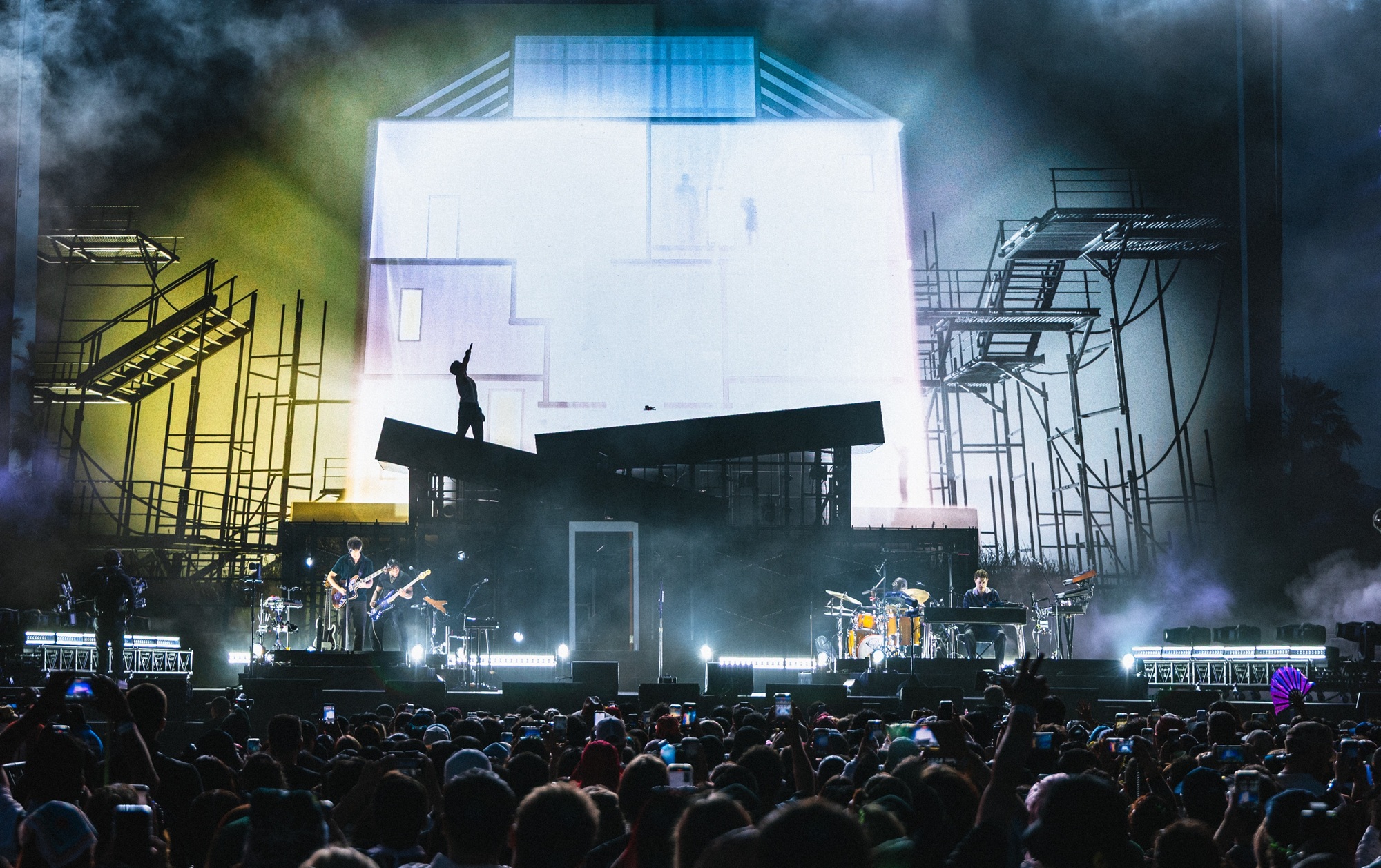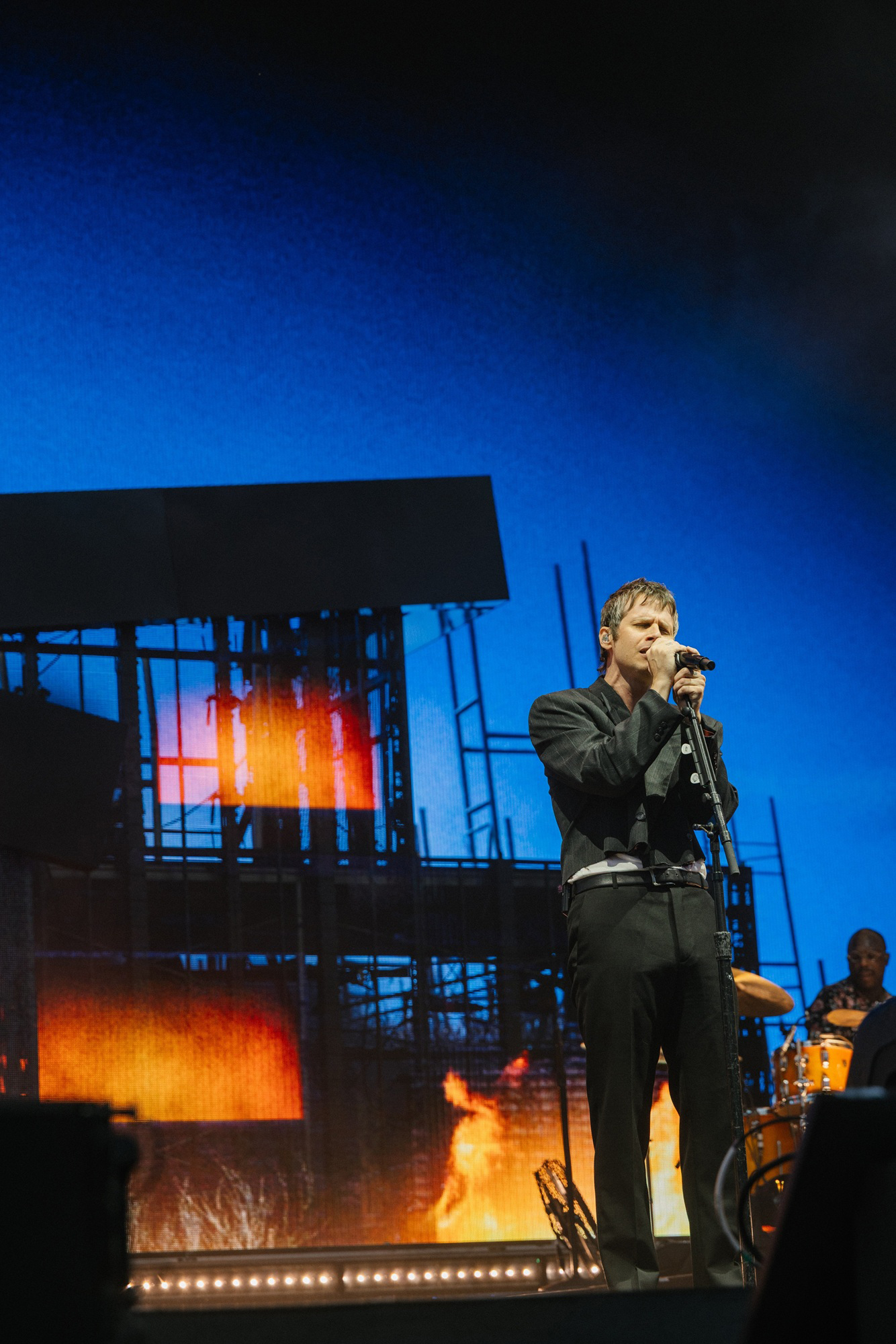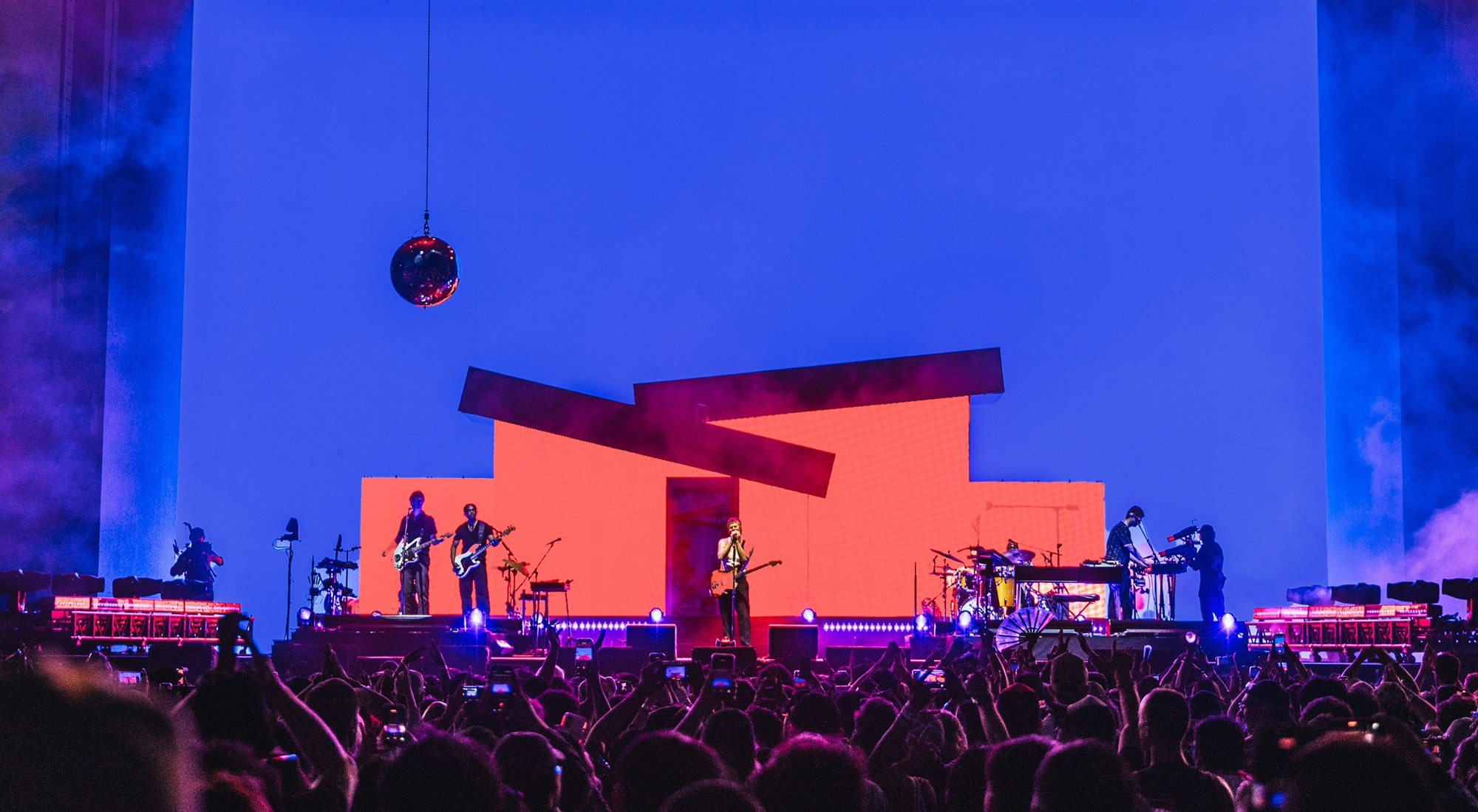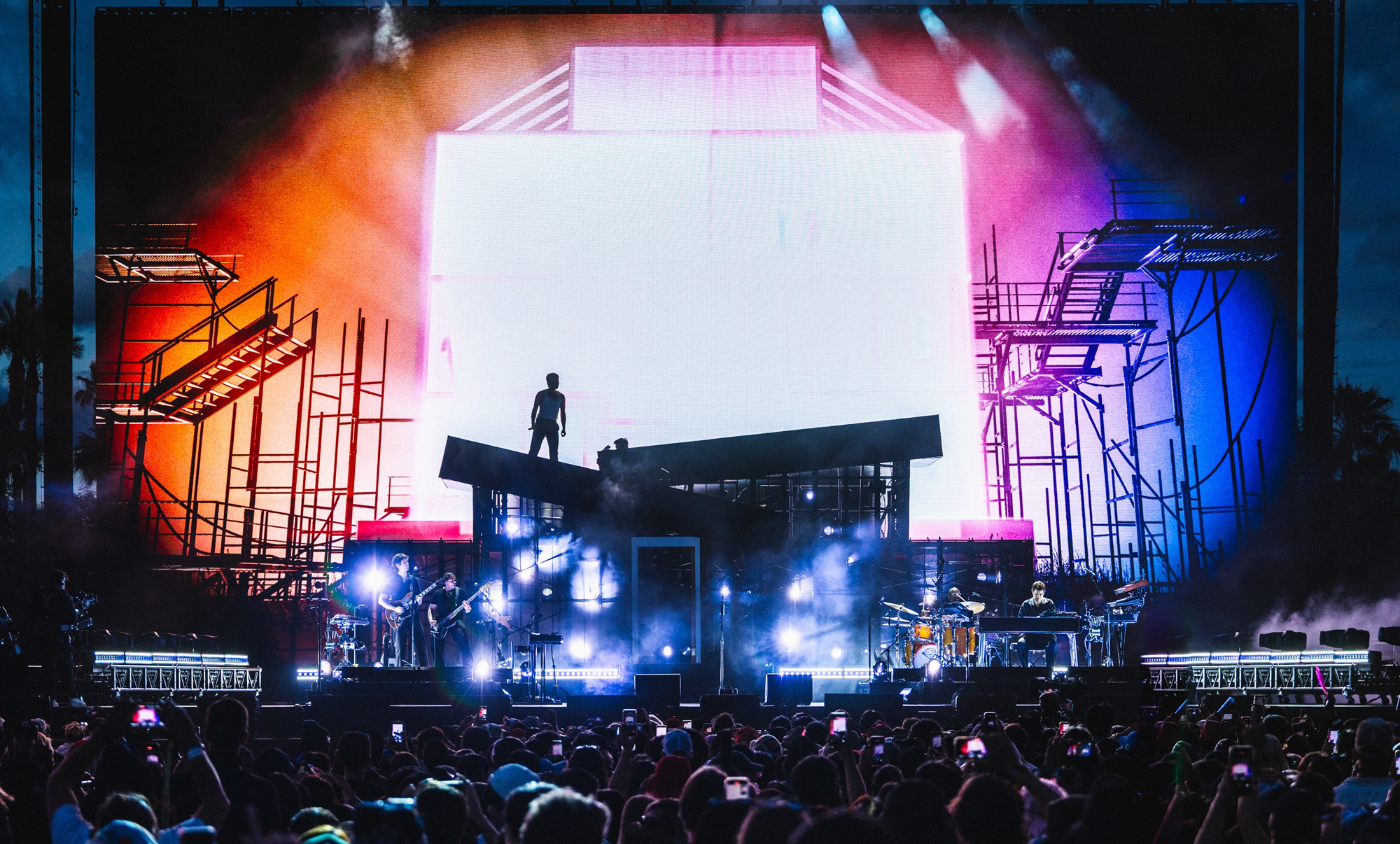
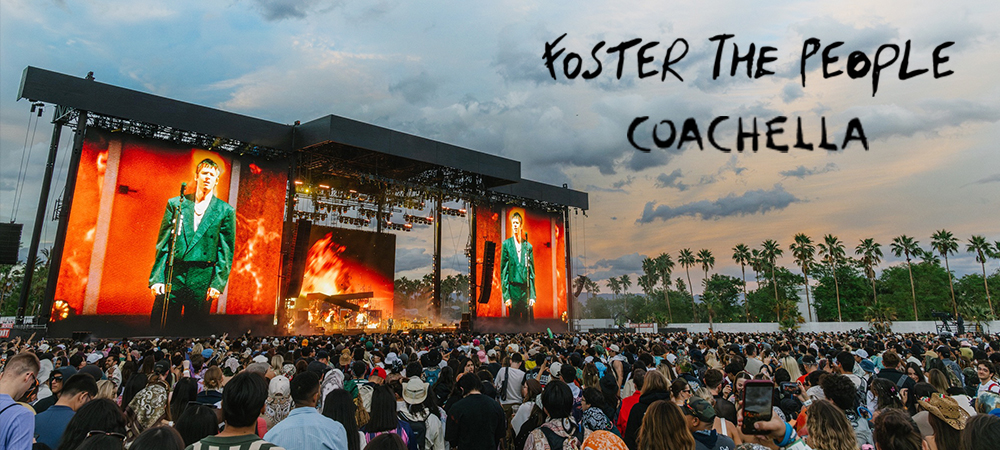
Over both weekends of this year's Coachella festival, audiences were treated to a visually captivating journey as indie pop band Foster the People took the stage at the iconic Outdoor Theatre. Creative director, production designer, and lighting designer Shepherd Lowrey crafted a unique experience that spanned the idealized optimism of the 1950s and the unsettling realities of modern surveillance culture. To help bring that concept to life, Lowrey leaned on Elation's Proteus Rayzor Blade L, using the fixture to deliver both expansive washes and dynamic visual effects that reinforced the show's evolving narrative.
Working in partnership with Nashville-based creative production company Cour Design, which produced the show, Lowrey helped create a concept-driven performance that blended the band's classic indie-pop catalog with the psychedelic influences of their album, Paradise State of Mind.
Lowrey, who has previously worked with Foster the People, was approached by Cour Design to lead the creative direction for the Coachella production. "I love Coachella and I'm always eager to do something there every year," said Lowrey, who lives just down the road from the festival grounds. "It's the biggest event of the year for me. It means a lot because it's in my territory and it's such an impactful showcase for agencies, creative houses, and production teams. I was especially excited to nail this show for Cour-they're doing great things these days, and I knew the bar was high."
A Conceptual Journey from Sweet to Scary
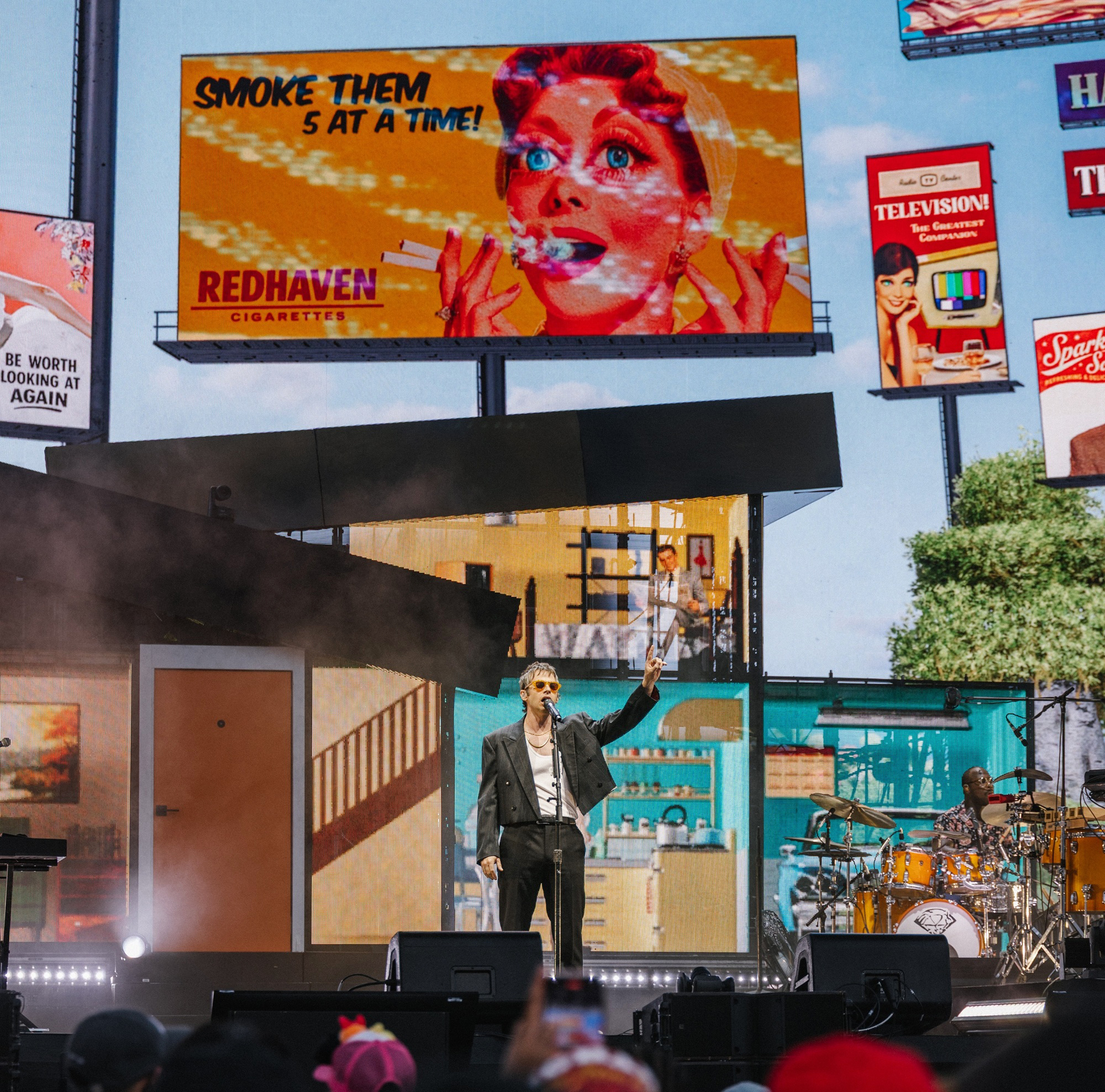
The production centered on a narrative concept developed with Foster the People frontman Mark Foster. "Mark came in with this idea of surveillance as a daunting, overarching theme," Lowrey explained. "We wanted to present it in a way that wasn't simply dark and depressing, so we explored the juxtaposition between an idealized, picture-perfect 1950s world and the realities of where we are today. We married those ideas as a journey from 1950 to 2026, starting bright and cheery before gradually becoming stranger and eventually over-the-top scary."
To support that story, the team constructed a striking stage environment centered around a 36-foot-wide by 12-foot-deep LED house inspired by the architecture of Palm Springs in the 1950s and '60s. Throughout the performance, a fictional family inhabiting the house appeared in video content that evolved alongside the show's narrative, while Coachella's massive upstage video wall and large side video screens expanded the visual canvas.
"We really wanted to bring that, albeit false, 1950s idealism to life and then slowly degrade it over the course of the set," Lowrey said. "It was definitely one of the most fun concepts I've ever been associated with."
Proteus Rayzor Blade
With video serving as the primary storytelling medium, lighting was tasked with reinforcing the narrative while maintaining visibility and impact against the extensive LED content. "The show was very video-heavy, with lighting in support," Lowrey noted, stating that the challenge was finding fixtures that could complement all of the video while still making a statement when needed.
For that role, Lowrey turned to Proteus Rayzor Blade L fixtures supplied by Christie Lites. The one-meter-long IP65-rated linear tilt FX bars, driven by 12 independently-controlled 60W RGBW LEDs, became a central element of the lighting design.
Mounted horizontally on rolling truss sections along both sides of the stage, six Rayzor Blade L fixtures per side delivered powerful sidelight and fill illumination across the band. An additional row of ten fixtures positioned upstage completed a near-continuous perimeter around the performance space.
"The reason we used them as sidelight is because they color wash so well," Lowrey said. "We used them constantly as fill light on the band because we wanted it to feel like they were being blasted from the sides. Then, when it was time for impact moments, we had all the strobe power we needed. That's what makes them such a useful two-in-one fixture."
Dual Purpose
The dual-purpose nature of the Rayzor Blade L proved particularly valuable in the festival environment. "If we were building this for a tour, we'd unpack the show in stages and save some of those effects for later," he said. "But because it was a festival show, we wanted to come out of the gate hard and just hit them with everything we had, at least in the first few songs. The Rayzors were instrumental because we could use them as a wash one moment and then shift gears with the strobe effects."
According to Lowrey, the fixtures quickly became the backbone of the rig. "To be honest, they were the workhorses of the show," he stated. "We leaned into them throughout pretty much the entire set."
The fixtures' brightness also proved critical when competing with the substantial LED video package. "They're such a powerful light," Lowrey said. "During rehearsals I was actually worried they might overpower the video because they're such bright fixtures. But ultimately that output gave us what we needed to hold our own against all the LED content."
More Design Options
Beyond wash and strobe duties, the designer also incorporated the fixture's automatic tilt functionality to reinforce the show's architectural themes. "We spent a lot of time trying to keep the visuals feeling very architectural," he explained. "Sometimes the fixtures would point straight up, other times directly into the stage. The tilt function gave us a lot of flexibility while supporting the overall design language."
The Rayzor Blade L's SparkLED background twinkle effect also played a memorable role during the show's finale, the band's signature hit "Pumped Up Kicks."
SparkLED uses dedicated white LEDs positioned within the fixture's lens to create an additional layer of visual texture. "For that song we wanted a very classic, elevated CTO look," Lowrey said. "The SparkLED effect was perfect for that moment. We actually shaped the rest of the look around it because it delivered exactly the feeling we were after."
Collaborative Effort
The rig also included moving head profile and beam/wash fixtures, along with other linear wash lights. Lowrey credits a collaborative team effort for helping to bring the production to life, including lighting director, programmer, and operator Scott Schirmer, account rep Sean Ray at Christie Lites, and Ariel Afar from production company SLX, who provided consultation during rehearsals.
Reflecting on the project, Lowrey praised lead singer Foster's creative engagement throughout the process. "I was very lucky to work with Mark Foster on this show," he said. "If you bring him a concept, he really sinks his teeth into it and takes it a million miles. That level of collaboration made the whole creative process incredibly rewarding."
Lowrey hopes to continue evolving the concept for Foster the People's upcoming "Good Mourning Sunshine" tour, scheduled to launch in September. However, plans for carrying the full Coachella production package forward remain undetermined.
Photos: Miranda McDonald